Follow One Sound Through a Film
Follow one sound through a film to hear how its texture, placement and relationship to the image shape a scene, with a simple method for taking notes.
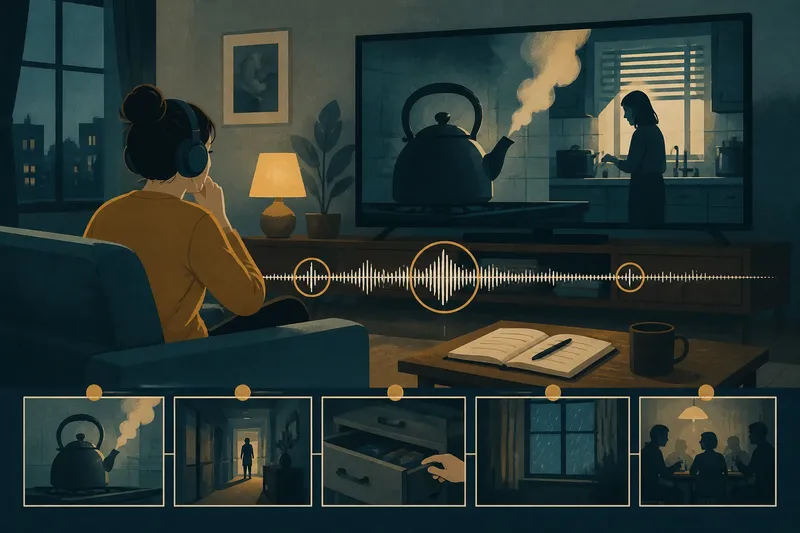
You are rinsing a mug when the kettle clicks off, and its small sound seems to linger in the quiet kitchen. Follow one sound through a film and you can notice how a soundtrack places it beside voices, music and silence. The point is not to decode a hidden message. It is to hear how a film builds a scene.
Choose a sound thread
Pick a sound you can recognise without effort: a bell, a repeated musical phrase, footsteps, a motor or rain against a window. It might return at intervals rather than every few minutes. Choose something that catches your ear, not something you have to strain to identify.
For a first watch, follow one sound and leave the rest of the soundtrack alone. On another evening, you could listen for how the music and room sounds share space. A narrow focus can make details easier to notice, while a broader one helps you hear the scene as a whole.
Captions can stay on if you rely on them for dialogue. You can use television speakers, a soundbar or headphones; each makes the room and soundtrack feel different. Set the volume at a comfortable level and choose the setup that suits your space.
Hear the texture
Texture is the character of a sound: its pitch, rhythm, distance and clarity. A clock’s tick might sound crisp in a quiet room, then seem muted beneath traffic or music. The recurring sound is recognisable, but the mix around it changes what reaches your ear.
Listen for what accompanies it. Are there footsteps, room tone, dialogue or a pause in the score? Does the sound seem close to the microphone or distant from the scene? You need no specialist terms. A note such as “clear, then covered by music” is enough to capture a change.
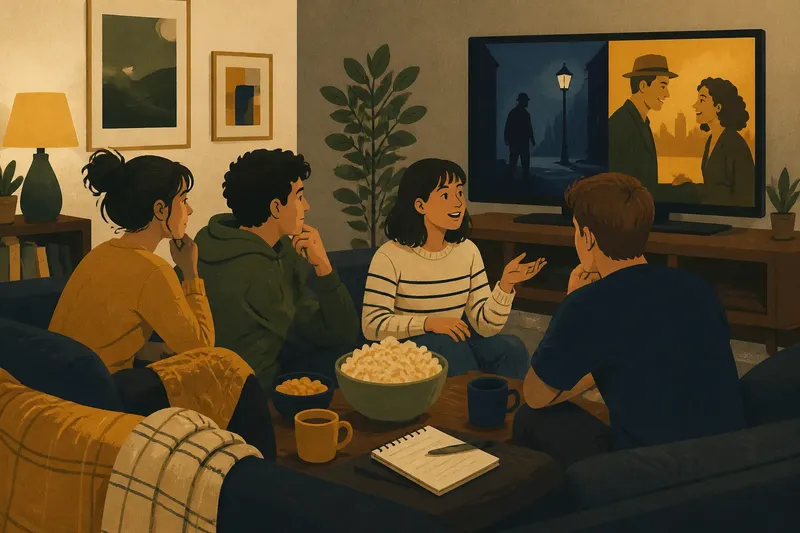
If you are watching with other people, keep notes until after the film. Writing mid-scene can pull attention away from a performance. A scrap of paper or a note in your phone works well afterwards; a few plain words will do.
Compare sound and image
A recurring sound can lead your attention towards something in the frame, or persist while the image moves elsewhere. Notice whether you see a likely source, whether the camera stays with it, and whether the sound continues across a cut. These are observations about how the film joins sound to image, not claims about what must happen next.
Say you are watching an invented mystery and hear a scrape twice. In the first scene, a character pulls open a drawer as the scrape sounds. Later, the scrape returns while the camera holds on a closed window. You note the two pairings: visible action first, an image without an obvious source second. The difference may make the window feel more present, but it does not establish that the sound is a clue. The useful result is a clearer account of how the film has arranged your attention.
Try separating what you hear from what you infer. “A low hum continues after the cut” is an observation. “Someone is hiding nearby” is an interpretation. Keeping those sentences apart lets you describe the film’s choices without turning a possibility into a fact.
Read the sound’s role
Sound can come from within the story’s space, such as a kettle boiling in a kitchen, or sit outside it, as a musical score often does. Some sounds are harder to place. A low drone might belong to a machine in the room, the soundtrack, or a blend of both. You can note that uncertainty as part of the listening.
Context also changes a sound’s feel. A piano note might seem gentle beneath a family meal, then unsettled in a silent corridor after an argument. The note itself may be unchanged; the acting, lighting, editing and surrounding quiet can alter its effect. Describe your response as yours rather than deciding what the filmmaker intended.
Silence matters too. A sound may stand out because the score drops away, dialogue pauses or background noise thins. If a repeated sound loses prominence when the scene fills with other noises, that shift is worth noticing. It tells you about the mix, even if it carries no special plot meaning.
Questions for listeners?
What if no sound repeats?
Choose a broader thread, such as a steady hum or recurring bursts of applause. If nothing holds your attention, let the exercise go and watch the film without a listening task.
Should I take notes?
Notes are optional; a few words after the credits can help you recall a change in texture or placement. If you would rather stay with the scene, keep the sound in mind and leave the notebook closed.
Are headphones better than speakers?
Headphones may make quiet details easier to separate, while speakers keep the soundtrack in the room with other listeners. Use whichever is comfortable and appropriate for your space; neither is required for attentive listening.
How do I avoid overinterpreting?
Write or remember the audible event first, then treat any meaning as a possibility. If the sound’s role remains unclear, leave it unresolved rather than making it carry a plot explanation.
Keep a small record
If you want a concrete record, use a simple three-column note: scene, sound, change. For example, write “kitchen, bell, clear”; then “hallway, bell, partly masked by voices”. That gives you something specific to compare without interrupting the film to build a theory.
- Check whether you can recognise the sound; if you can, follow it, and if you cannot, choose a clearer thread.
- Check whether it returns in a different setting; if it does, compare the surroundings, and if it does not, stop tracking it.
- Check whether its pitch or rhythm changes; if it does, note the change, and if it stays similar, listen to what sits around it.
- Check whether the sound has a visible source; if it does, note the image and sound together, and if it does not, record “source not shown”.
- Check whether it continues across an edit; if it does, note where the image changes, and if it stops, notice what replaces it.
- Check whether music or dialogue masks it; if they do, note what covers the sound, and if they do not, listen for changes in distance or clarity.
- Check whether a pause or quieter passage makes it stand out; if it does, note the contrast, and if it does not, keep listening without forcing a pattern.
Follow one sound through a film as a way to notice craft: texture, placement, silence and the relation between what you hear and what you see. A modest note can preserve the detail that caught your ear. It need not explain the whole film; sometimes the useful discovery is simply that the soundtrack changed around a sound you already knew.